Non-Planar π-Systems and Polycyclic Aromatic Hydrocarbons

Our research is focused on the synthesis and functional investigation of non-planar polycyclic aromatic hydrocarbons (PAHs) and π-conjugated macrocyclic architectures. Incorporating benzenoid and quinoid building blocks into strained cyclic frameworks generates curved and helically twisted π-surfaces, where steric effects and strain relaxation give rise to distinctive structural and electronic properties that are absent in planar aromatic systems. These architectures provide a unique platform for understanding how molecular topology influences π-electron delocalization, aromaticity, and intermolecular interactions. The ability to precisely tailor the geometry and electronic structure of such curved PAHs offers exciting opportunities for the development of advanced materials for organic electronics, optoelectronics, chiroptical devices, molecular sensing, and energy-related applications. Their tunable optical and charge-transport properties make them promising candidates for next-generation organic semiconductors and responsive molecular systems.
Chiral Macrocycles and Functional Materials
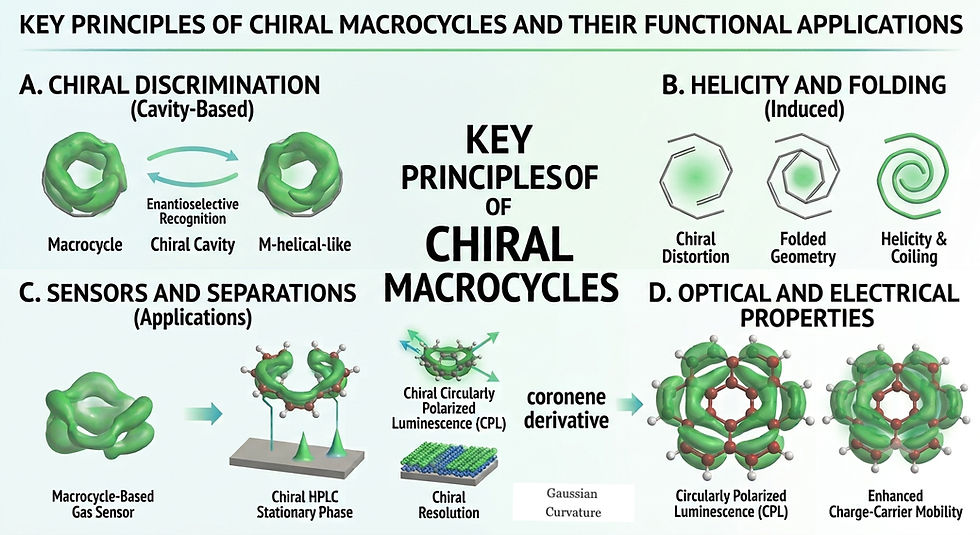
An important aspect of our research involves the synthesis of configurationally stable chiral π-conjugated macrocycles and helically twisted PAHs. The objective is to establish efficient synthetic approaches toward molecular systems that combine structural robustness with desirable physicochemical characteristics such as self-assembly, and liquid/solid-state conductivity. These chiral architectures exhibit intriguing chiroptical and luminescent properties and are attractive for applications in circularly polarized luminescence (CPL), redox-switchable materials, organic light-emitting devices (OLEDs), and molecular electronics. Understanding the interplay between helical chirality and electronic communication is essential for translating molecular asymmetry into functional properties.
Redox-Induced Aromaticity and Organic π-Magnets

Another major research direction focuses on the relationship between aromaticity, redox chemistry, and spin phenomena in conjugated macrocyclic systems. Redox processes can induce profound changes in electronic delocalization, leading to unusual aromatic or antiaromatic states accompanied by remarkable optical and magnetic responses. Particular interest lies in the generation and stabilization of open-shell radical species within PAH-based macrocycles, enabling the construction of organic π-magnets. Spin coupling through conjugated pathways and through-space interactions in chiral environments provides access to interesting magnetic phenomena and spin-selective processes. These studies contribute to the understanding of molecular magnetism and the design of multifunctional materials for spintronics, quantum information technologies, and chirality-induced spin selectivity (CISS). Current efforts are directed toward expanding structural complexity through higher-order π-conjugated macrocycles, with the aim of uncovering new spin-coupled and redox-responsive behaviours.
Photoactive PAH Macrocycles for Biomedical Applications
The strong light-harvesting capability and tunable excited-state properties of π-conjugated macrocyclic systems also offer exciting opportunities in photodynamic therapy (PDT). PAH-incorporated macrocycles can be engineered to efficiently generate reactive oxygen species upon photoexcitation, enabling targeted destruction of cancerous tissues with minimal invasiveness. By combining extended π-conjugation with redox activity and molecular chirality, these systems hold promise as multifunctional theranostic materials capable of simultaneous imaging and therapy. Understanding the relationships between molecular structure, excited-state dynamics, and singlet oxygen generation is expected to facilitate the development of next-generation photoresponsive materials for biomedical applications.
